Outback vs Crown Signia: 2026 Subaru and Toyota SUV Test
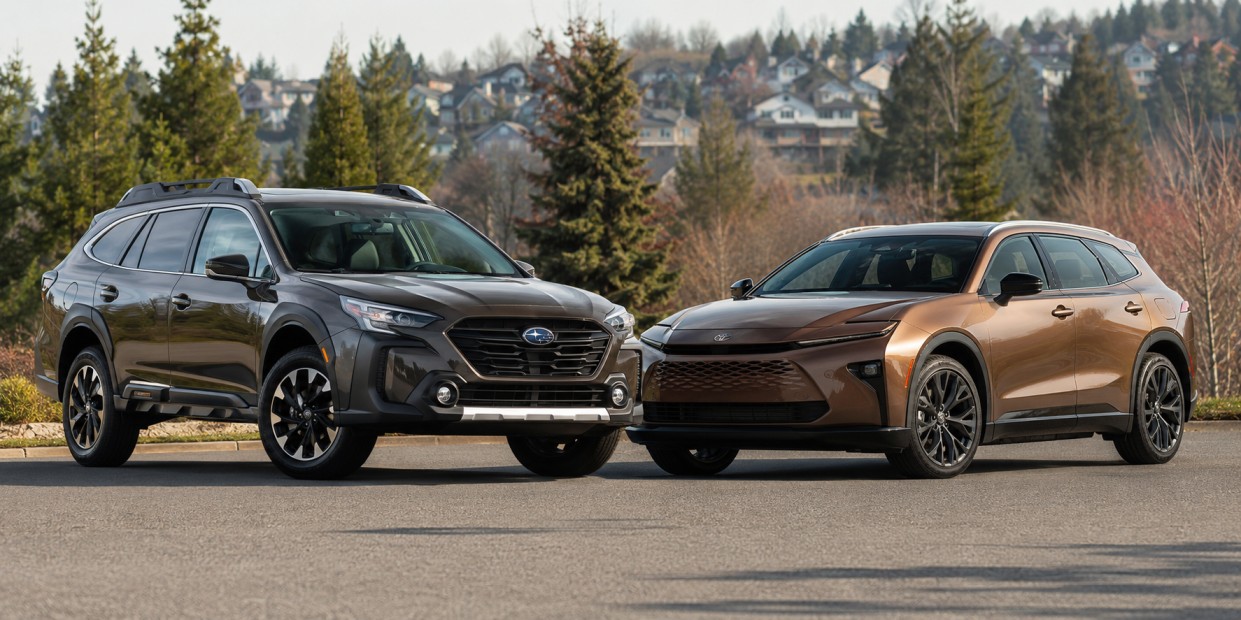
The 2026 Subaru Outback and Toyota Crown Signia sit in the same midsize crossover class. They take different paths. The new Outback looks more rugged and SUV-like. The Crown Signia stays lower and more wagon-like. Both offer all-wheel drive and room for Canadian families.
Space and Cargo
The Outback is taller and offers more cargo room. It holds 980 litres behind the rear seats and 2,280 litres with the seats folded. The Crown Signia offers 702 litres seats-up and 1,872 litres seats-down.
Passenger space is close. The Outback edges ahead on paper for headroom, legroom, and hip room. Both feel roomy enough for adults in both rows.
Power and Fuel Use
The tested Outback Premier XT uses a turbocharged 2.4-litre boxer four-cylinder. Reviewers found it quieter than expected. The Crown Signia is hybrid-only. Its 2.5-litre four-cylinder plus electric motors make 240 horsepower.
The Toyota wins on efficiency. Natural Resources Canada rates the Crown Signia at 6.2 L/100 km combined. Testers recorded about 6.4 L/100 km. The hybrid system is quiet at low speed. The gas engine can sound coarse under hard acceleration.
Price and Cabin
Canadian pricing favours the Subaru. The Outback ranges from $40,895 to $51,195. The tested Premier XT lists at $51,195. The Crown Signia Limited starts much higher, around $58,305. With the Advanced Technology Package, the tester reached $61,285.
Both cabins include heated and ventilated front seats, wireless phone charging, and wireless Apple CarPlay and Android Auto. Testers preferred the Outback’s two-tone interior and sharper screens. The Toyota cabin felt less special for its price.
Which One Fits Better?
Choose the Subaru Outback if you want more cargo space, a lower price, a taller ride, and a more rugged look. Choose the Toyota Crown Signia if fuel economy and a smoother, more urban style matter most.
The Outback vs Crown Signia choice is clear. One is the practical, value-focused crossover. The other is the efficient hybrid with a more refined road presence. Both work well as two-row family vehicles in Canada.