NACS vs CCS Canada: Which EV Charging Standard Should You Use?
Every Canadian EV owner who has ever sat in traffic wondering whether their charger is going to work is asking the same question: NACS vs CCS — which standard actually matters for their daily drive and long highway trips?
The truth is simple and important. These two systems power nearly every public and home charger across the country. Getting it right can save you hours of frustration, extra fees, and even missed appointments. In this clear guide, I’ll walk you through everything like we’re talking over coffee — no jargon, no confusion, just straight answers you can use today.
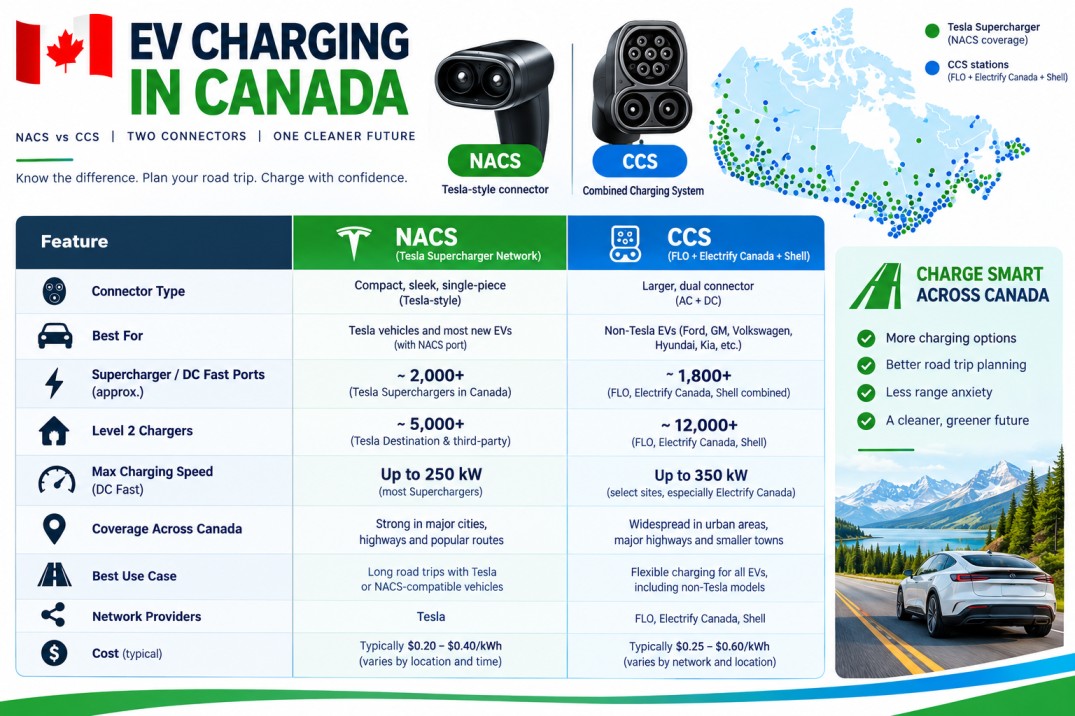
NACS vs CCS Canada at a glance
Here’s the straightforward head-to-head comparison based on the latest 2026 data from Natural Resources Canada and industry reports:
| Feature | NACS (Tesla Standard) | CCS (North America) |
|---|---|---|
| Connector | Compact Tesla-style | Larger J1772-style with CCS adapter |
| Top Speed | 250 kW+ (up to 350 kW) | 350 kW (most common in Canada) |
| Best For | Tesla owners + growing non-Tesla access | Most other EV brands (Hyundai, Kia, VW, etc.) |
| Canada Coverage | Tesla Superchargers + partner sites | FLO, Electrify Canada, Shell, Electrify America |
| Plug & Charge | Strong and growing | Widely supported |
| Adapter Needed | None (if car supports NACS) | Often required for Tesla vehicles |
| Price (DC fast) | $0.35–$0.55/kWh | $0.25–$0.50/kWh (varies by network) |
These numbers shift quickly as new stations open. Still, the pattern is clear: NACS is faster and simpler for Tesla owners, while CCS remains the safe choice for the majority of Canadian EVs.
NACS: The future of Canadian EV charging
NACS (North American Charging Standard) is the compact connector Tesla created and the industry is now adopting at speed. In Canada, Tesla’s Supercharger network has added nearly 2,000 new DC fast ports in 2025 alone.
Many non-Tesla brands have already joined the network. Volkswagen, Toyota, Porsche, and some Stellantis models can now charge at Tesla stations using either a native NACS plug or a simple, free adapter. Newer stations regularly reach 350 kW, making it one of the fastest options available right now.
Best for:
- Tesla owners
- Drivers who want one simple app and network
- Cross-border trips into the United States
Drawbacks:
- Some newer models still require an adapter
- Not every public station in Canada is NACS yet
Verdict: Perfect for Tesla drivers — and it’s growing fast. But it’s not yet the universal standard.
CCS: The proven workhorse of Canadian charging
CCS (Combined Charging System) is what the vast majority of EVs sold in Canada actually use. It works seamlessly with Level 2 home chargers and every public DC fast station on FLO, Electrify Canada, Shell Recharge, and Electrify America.
Hyundai, Kia, VW, Mercedes, BMW, and almost every other major brand ship vehicles with CCS plugs. That means you can charge almost anywhere you see a Level 2 or DC fast charger in the country.
Best for:
- Everyday home charging
- Cities and destination stops
- Non-Tesla EV owners
Drawbacks:
- Slightly larger plug than NACS
- Slower maximum speed on some older CCS stations
Verdict: The safe, reliable choice for most Canadian drivers today.
Which standard should you pick for Canada?
Use this simple, practical plan:
- Check your car’s manual or build sheet — does it have a native NACS port?
- If you drive a Tesla or any NACS-compatible model, open the Tesla app or Supercharger map first.
- If you have any other EV, simply open the FLO, Electrify Canada, and Shell apps — they all use CCS.
For a typical Canadian road trip, the smartest move is to carry both options (or just the one adapter most people use). Newer chargers are increasingly dual-port (CCS + NACS), so you’ll almost never be stuck.
Also remember: Plug & Charge is now available on almost every major network in Canada, which removes the need to open the app every time you stop.
Practical verdict
NACS vs CCS Canada is no longer about “which one is better.” It’s about understanding both so you can charge anywhere without stress.
- Tesla owners: Use NACS Superchargers first.
- Everyone else: Use CCS on FLO, Electrify Canada, or Shell.
The good news? Canada is moving toward one universal standard, just like the United States. By 2030, most public chargers will be dual-port or fully NACS. Until then, knowing the difference makes every trip smoother and cheaper.
For the latest charger maps and pricing, check Natural Resources Canada’s station locator, PlugShare, and the apps from FLO, Electrify Canada, and Tesla.